Chapter 1
This far down, the implosion would kill you long before the pain signal reached your brain.
Dr. Emma Sullivan had first read that in a National Geographic feature, which explained the physics in calm, almost reassuring language—a pressure failure would happen faster than the human nervous system could process it.
There were worse ways to die, though Sullivan tried not to consider any of them as the submersible descended through the Mariana Trench.
Its exterior lights cut a narrow path through the black water, and somewhere behind her seat, metal creaked beneath the mounting load.
She kept her eyes on the porthole and tried not to imagine the weight of the Pacific pressing against the hull—at Poseidon-1, their ultimate destination, more than thirty-six thousand feet of water would be stacked above them.
Her right boot had begun pinching her smallest toe. Naturally, that was what her mind chose to focus on.
They were bound for Sirena Deep, one of the least explored sections of the trench, where only a handful of crewed expeditions had ever entered. Much of it remained mapped only by sonar, with gaps where the terrain dropped too sharply or the signals came back distorted.
Poseidon-1 had been built inside one of those gaps, and the depth display had already passed twenty-eight thousand feet.
Sullivan sat upright beneath the low cabin lights, her auburn hair secured behind her head, wearing company coveralls and heavy boots, both hands resting against her thighs. The fingers of her right hand trembled once before she pressed them into the fabric and found the depth display again.
Across from her, Captain Samuel Thayne watched the instrument panel. He had a broad face, a neatly trimmed gray beard and the tired eyes of a man accustomed to carrying responsibility. His company photograph had made him look heroic; in person, he simply seemed short on sleep.
Mark Bindy occupied the seat beside him, thick through the shoulders, with close-cropped hair and a heavy jaw, looking as though the cramped submersible had personally offended him.
Ronnie Carter sat beside Sullivan, her posture straight and her expression unreadable. Before departure, she had checked Sullivan’s harness herself, pulling each connection hard enough to make the webbing bite into her shoulders, and had spoken no more than six words since.
Sullivan knew what Carter thought of her, or believed she did.
The hull gave a low groan. Bindy glanced toward the sound, then at Sullivan—his expression hadn’t changed since she’d stepped aboard. Perhaps he had indigestion; the thought nearly made her smile.
Thayne finally spoke. “Poseidon-1’s the deepest permanent mining installation ever built. Some people say working down there is more dangerous than space.”
“Space doesn’t squeeze from every direction,” Bindy said.
Thayne shrugged. “The vacuum still does its part.”
Bindy did not smile.
“They don’t trust you,” Thayne said.
“I gathered that.”
Her British accent had softened during her years in the United States, but it returned whenever she chose her words carefully.
Thayne nodded toward Carter and Bindy. “Most of the senior crew worked aboard Njord.”
“I know.”
“Far as they’re concerned, you cost them their jobs. Some even their lives.”
Sullivan kept her eyes on Thayne. Her thumb found the seam of her coveralls and pressed. “Someone gave me a report. Serious structural problems. I passed it to the regulators. They made the decision.”
Thayne didn’t look away. “Who gave it to you?”
Carter shifted in her seat. She was interested, though clearly trying not to show it.
“Someone slipped a USB drive under my cabin door. Stress readings, weld inspections, warnings that had been downgraded or left unresolved. I never confirmed the source. My guess was a junior structural engineer—someone who’d already raised the flags and been ignored.”
“Convenient,” Bindy said.
“I took the files to Carter first.”
“I believed the risk was manageable,” Carter said.
“You believed additional monitoring was sufficient. I didn’t.”
“So you went around me.”
“I sent the files to regulators.”
Bindy leaned forward. “And the platform got evacuated. Repairs started. Everyone lost their contracts for nothing.”
“Yes.” Sullivan let a breath go before she went on. “And the platform collapsed six weeks later—during the reinforcement work.”
That slowed him, though only briefly. “Convenient timing,” Bindy said. “Boys online reckon the reinforcement crew weakened it themselves—got in over their heads patching something that wasn’t broken.”
“Don’t believe everything you read online,” Sullivan said.
Color rose along his neck; he opened his mouth, closed it again, and looked away.
Thayne observed the exchange without interrupting.
“You’d make the same call again,” Bindy said.
“With the same evidence—yes.”
Bindy gave a humorless laugh.
Sullivan could have stopped there—nothing she said during the descent would restore lost wages or repair Carter’s humiliation. Still, she saw how tightly Bindy’s hands had closed.
“People were hurt by the shutdown,” she said. “I’m sorry for that.”
He looked back at her, suspicious now.
“But evacuating the platform was the right decision.”
The submersible creaked around them.
Bindy settled back.
Thayne broke the silence. “You knew this crew would be here when you applied.”
“I did.”
“And you came anyway.”
Sullivan looked through the porthole. The lights illuminated drifting particles and brief flashes of glassy life. “The pay was competitive.”
Bindy gave a quiet snort.
Outside, a juvenile bigfin squid drifted into the lights. Its translucent mantle was no longer than Sullivan’s hand, with two broad fins opening from it like pale wings, and slender arms trailing beneath the body, wavering in the current like loose threads.
She recognized it immediately. Magnapinna. Rarely observed alive and almost never from a crewed vessel.
The squid hovered beside the porthole, its fins pulsing with slow, delicate strokes. Sullivan leaned closer without touching the glass, following the movement of its arms and the faint adjustment of its fins against the current.
She wondered whether seeing something so rare before reaching Poseidon-1 might be a good omen. She did not normally believe in omens, but thousands of feet beneath the surface, she was willing to make an exception.
The squid folded itself into the darkness and disappeared.
This was part of the reason she had come: around Poseidon-1 lay an ecosystem almost no one had studied, isolated by pressure, darkness, and millions of years of adaptation.
The other reason waited in a care facility.
Her father had once lectured to packed university halls without notes; now Lewy body dementia took pieces of him without warning. Some days he recognized her immediately. On others, he asked when Emma would arrive while she sat right beside him.
Poseidon-1 offered enough danger pay to cover the overnight care she feared his insurance might not.
She had promised herself the assignment would be temporary: two weeks at the bottom of the world, then home.
The submersible lurched deeper.
Carter eventually spoke. “You’ve read the depth protocols. Emergency procedures.”
“Twice. And yes.”
“Medical isolation. Xeno certification.”
“Yes. Completed in Norfolk.”
Bindy asked, “Simulator or pressure chamber?”
“Both.”
“Simulator doesn’t count.”
“Pressure chamber does.”
“Nothing at the surface counts down here.”
Carter said, “Neither does unsettling a new crew member for your own amusement.”
Sullivan looked from one person to the next.
“Is this everyone coming down this rotation?” she asked.
Thayne shook his head. “Seven came down ahead of us. Permanent complement is thirty-one, split across rotations. Most are working or asleep.”
“We waited for your medical clearance,” Bindy said.
“The company ordered another cardiac scan after reviewing the depth specifications. Apparently my heart remains adequate.”
“Glowing endorsement,” Bindy said.
Thayne asked Sullivan, “First impressions matter down there. How do you think yours is going?”
“I don’t think charm was ever going to solve this.”
“Good. You appear to have left it ashore.”
Carter looked away, but Sullivan caught the beginning of a smile. Outside the porthole, silt drifted up through the lights and fell away into the black.
Thayne folded his hands over his stomach. “You should know, when I saw your name on the roster, I tried to have you removed.”
Sullivan waited.
“I told management you’d hurt morale. Half the crew wouldn’t trust you, and the other half would expect you to close us down.”
“And what did management have to say?”
“That you were the most qualified biologist willing to come.”
“Most qualified or only?”
“Both.”
Carter closed her eyes; Bindy followed several minutes later. Thayne remained awake, watching the instruments and occasionally checking the navigation feed at his station.
Sullivan pulled up the Poseidon-1 briefing on her tablet.
The rig had begun as a deep-sea mining experiment after remote vehicles detected a rich deposit of Nerunium, a rare metallic element prized for the pressure-resistant alloys used in deep-ocean construction, near Sirena Deep.
Poseidon-1 now housed laboratories, drilling systems, processing facilities, emergency shelters and a docking station for full-depth submarines.
Every major system had backups, and even the backups had backups.
The documents emphasized that several times, and Sullivan wondered whether repetition made the systems any safer.
She scrolled through the personnel section, where several names were familiar from Njord—the summaries listed certifications, specialties, and emergency qualifications.
She closed the file.
The cabin lights dimmed briefly before returning to normal. Carter’s eyes opened at once.
“Routine power adjustment,” Thayne said.
“I didn’t ask.”
“No. You only looked ready to dismantle the submersible.”
Carter closed her eyes again.
Sullivan studied her. Njord had made Carter afraid of being careless.
Sullivan knew something about that.
The cabin speaker chimed with an automated announcement: “Docking in four minutes and fifty-eight seconds.”
Nearly two hours had passed.
Bindy straightened as Thayne nudged his boot. Carter rolled her shoulders and ran her eyes over Sullivan’s harness once more without touching anything.
Sullivan leaned toward the porthole. At first she saw only the submersible’s lights reflected against drifting sediment. Then another light appeared. A second joined it. Then twenty.
Poseidon-1 emerged from the darkness one section at a time.
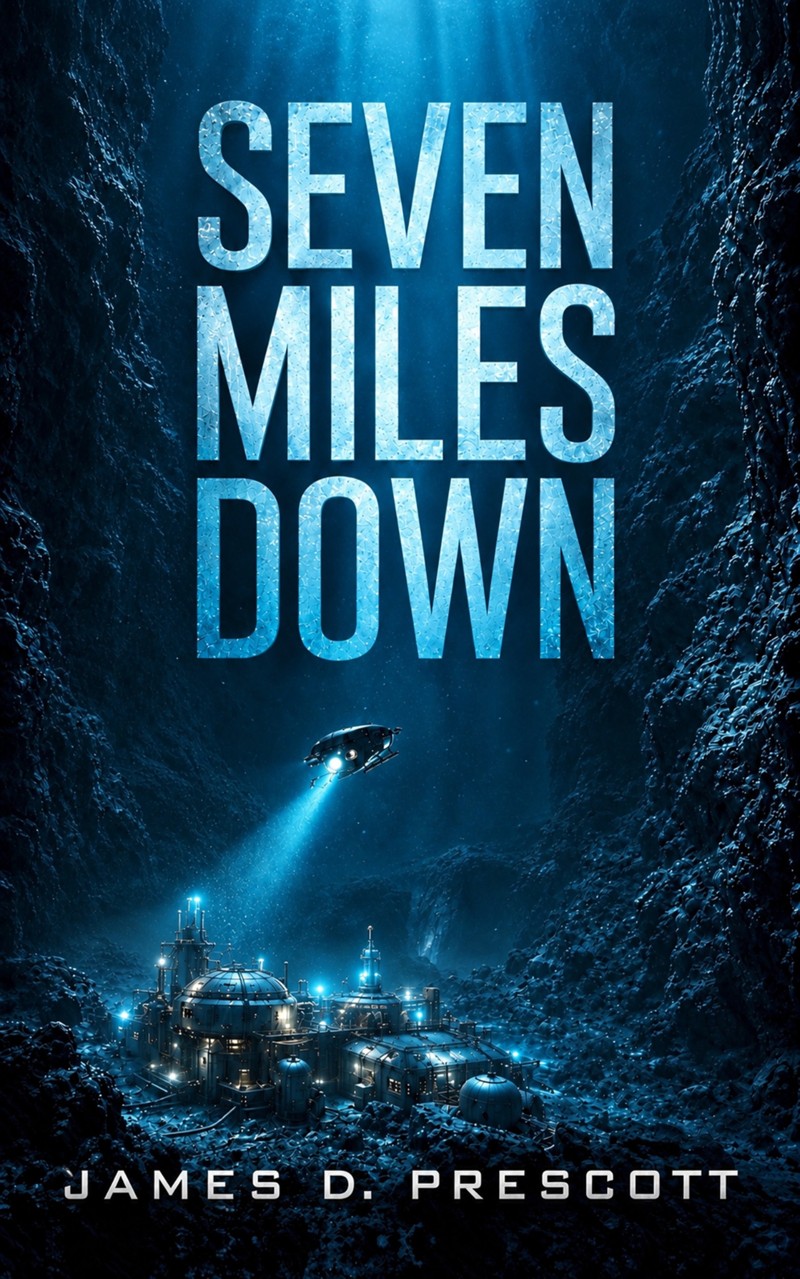
The installation rested against the wall of a deep underwater valley, surrounded by rock formations rising beyond the submersible’s lights. A central tower formed the core of the rig, with reinforced corridors extending from it like spokes, connecting laboratories, crew modules, machinery bays, storage sections, and drilling platforms.
Floodlights washed the structure in white light while construction arms and extraction equipment hung over the seabed, and smaller vehicles wove between docking stations, their beams crossing through the water.
The rig was much larger than the briefing images had suggested. It resembled a colony on some distant moon, transplanted whole to the bottom of the Pacific.
For a moment, Sullivan forgot about the pressure.
Thayne watched her take it in. “If I had a nickel for every time I saw that expression.”
“The photographs don’t come close.”
“They never do.”
As the submersible banked toward the docking structure, Poseidon-1’s lights spilled across the valley, revealing ridges, broken cliffs, and deep channels that continued beyond their reach.
No sunlight had ever touched this place, and beyond the rig’s surveyed perimeter, much of the seabed had never been seen directly by human eyes.
Sullivan followed the lights across the bottom, where thin tracks ran between the docking station and the mining zone—but beyond them, the silt was undisturbed. Small organisms clustered near warmer equipment housings, taking advantage of the heat and vibration.
Human machinery had already begun creating an ecosystem of its own.
She wondered what had lived there before Poseidon-1 arrived, and what had moved away when the drilling began.
Sullivan was nine again, watching her father lower a sampling net into the water and waiting to see what came back up.
Look properly, Em. Most of the world hides in plain sight.
Below them, a small white shape slipped between two ridges, stopped beneath the submersible’s light, unfolded six narrow limbs, and buried itself in the silt.
Sullivan tracked the disturbed sediment until it cleared, fixing the location in her mind before the memory loosened its hold.
“Like glimpsing the face of God,” Carter said quietly.
The hardness had left her expression.
Bindy stared at the illuminated rig. “No gods here.”
The docking arms opened ahead of them.
As the submersible aligned with the station, a vibration passed through the cabin. Bindy laced his fingers together so tightly his knuckles whitened.
Sullivan first thought he was bracing for impact—then she recognized the shape of prayer.
He noticed her looking and separated his hands self-consciously. She turned back to the porthole before he had to defend himself.
“Down here,” Carter said, “we’re on our own.”
Sullivan watched Poseidon-1 fill the glass and felt the fear return beneath the wonder. The station was immense, but the darkness beyond it was larger.
A stray thought drifted through her mind, unwelcome and impossible to shake.
We were never meant to come here.
© 2026 James D. Prescott. All rights reserved.